Ma Rainey—Sturdyvant
Ma Rainey's Black BottomMa Rainey—Sturdyvant is a tense professional relationship in which control of the recording process is repeatedly contested. Sturdyvant can set the studio’s schedule and offer money for music, but Ma insists on authority over her performance and uses the prospect of withholding future recordings to press for fair treatment. Their dealings make the studio a place where artistic decisions, labor, and commercial leverage collide.
Unequal positions in the studio
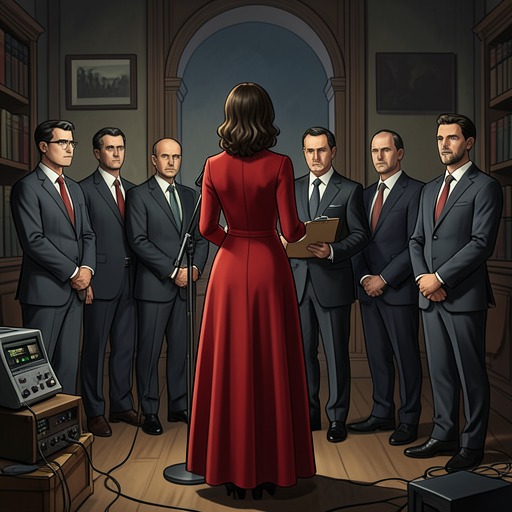
The relationship is established through a sharply divided recording space. The band room lies in the basement, while the studio is upstairs, with a control booth at the rear reached by a spiral staircase. A horn connects the control room to the performers. At the opening, Sturdyvant is visible in the booth, putting on earphones as Irvin tests a microphone and piano. The arrangement gives Sturdyvant a position from which to listen and direct the session while remaining physically apart from the musicians; communication across the horn reinforces that separation.
Sturdyvant’s authority is commercial as well as spatial. He is described as preoccupied with money and insensitive to Black performers, whom he prefers to deal with at arm’s length. He tells Irvin, Ma’s manager, to keep her in line and makes Irvin responsible for her conduct. His plan is to bring her in, record the songs on the list, and get her out on schedule. When he dismisses the title Mother of the Blues, his response makes clear that he regards Ma’s public standing as less important than completing the work efficiently.
Control over the music and the session
The conflict becomes explicit when Irvin explains that he and Sturdyvant have decided what would be easier to record. Ma challenges the authority implied by their joint decision: she will not accept their judgment as a substitute for her own. She says she listens to her heart and the voice inside her, then gives Irvin instructions to relay to the studio. Sylvester is to provide the spoken introduction to the song, while Levee is not to alter it with his music. If those terms are unacceptable, she says, she can take her act back South on tour.
This is not a rejection of recording, but a demand that recording follow her artistic decision. Sturdyvant later intervenes over the speaker to tell Ma not to wait so long before entering. She answers that he should take care of the control room and leave the singing to her, then asks where her Coca-Cola is. When she discovers it has not been provided, she refuses to sing without it and walks away from the microphone. Sturdyvant enters from the booth to protest: Ma arrived an hour late, the session is behind schedule, the band is ready, and he has spent money on lights and heat. Ma tells him to get out of her face. Their dispute over a drink and an entrance cue thus unfolds within the larger question of who gets to determine the conditions of her performance.
The session’s technical breakdown further exposes the limits of Sturdyvant’s control. After the band has played, he announces over the speaker that the song has not been recorded. Irvin identifies the problem as a chewed-up microphone cord and says another is needed. Ma calls the operation disorganized and leaves to get her coat, taking Dussie Mae with her. The play does not attribute the damaged cord to either Ma or Sturdyvant; instead, the failure interrupts the schedule Sturdyvant has been insisting upon and gives Ma another reason to end the session on her own terms.
Payment, consent, and the closing bargain
The dispute over Sylvester’s pay tests whether Ma’s authority extends beyond the performance itself. Irvin reports that Sturdyvant’s best offer is to take twenty-five dollars from Ma’s money and give it to the young singer. Ma rejects the proposal: if she wanted Sylvester to receive her money, she could give it to him herself; he is supposed to be paid in his own right, like everyone else. She directs Irvin to return to Sturdyvant and warns that he will not make another record of hers if he does not pay Sylvester. Her appeal turns the possibility of future work into pressure for immediate payment.
Sturdyvant ultimately agrees to pay. He gives Irvin two hundred dollars for Ma and twenty-five for Sylvester, and Irvin passes the money to them. The payment answers Ma’s demand, but it does not end the negotiation over the recording. When Sturdyvant asks her to sign the release forms, Ma points out that his mistake was discovering she had not yet signed. She initially leaves without signing and tells Irvin to have the forms sent to her address. After Irvin says he has taken care of everything, she asks for his pen and signs, but couples that consent with a warning: another mistake, and she can make her records elsewhere.
The relationship therefore ends neither in a simple victory for Sturdyvant nor in Ma’s refusal to participate. He secures the signed forms, while she secures Sylvester’s separate payment and makes her continued business conditional. The recording space may place the company in control of equipment, schedule, and money, but Ma repeatedly asserts that those controls do not settle who governs her music or what obligations the company owes the people making it.